



What started as an attempt to ease the morning traffic squeeze around Willoughby Public School is now being rolled out elsewhere, after the local program recorded more children walking and cycling and fewer cars around the school at peak times.
Willoughby Public School was the testing ground for the Active Routes to School approach, developed after the school’s P&C approached Willoughby City Council in 2022 with concerns about congestion and pedestrian safety at drop-off and pick-up.
Students became part of the solution.
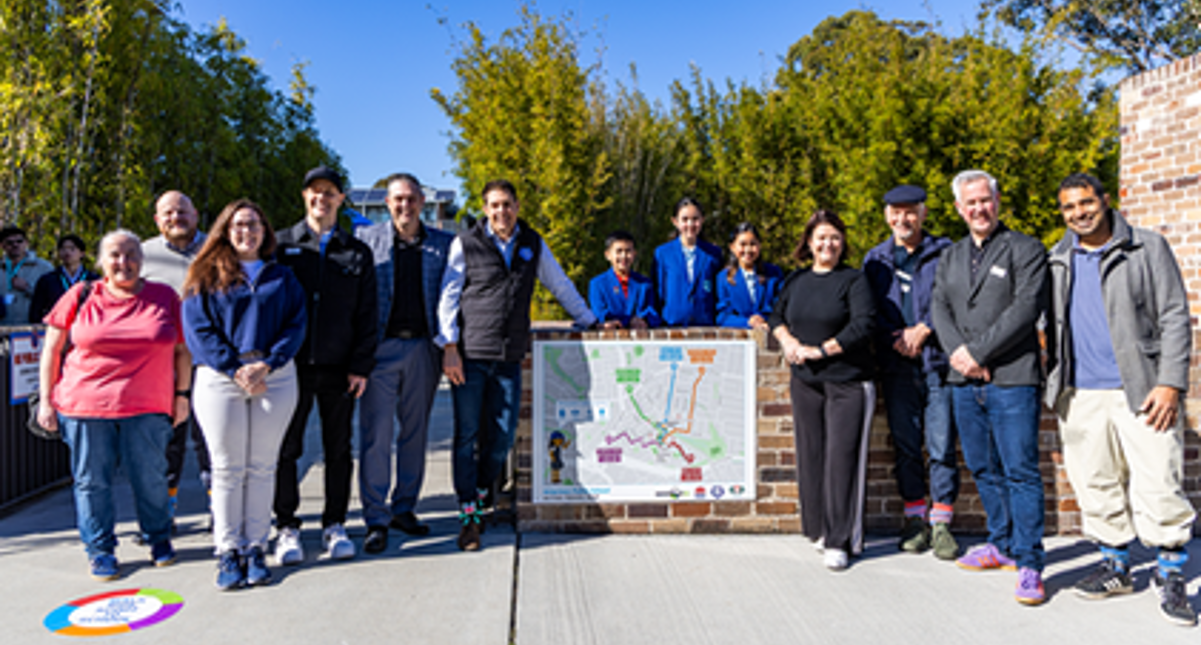
Working through geography lessons, they identified four routes they considered suitable for walking and cycling to school. Those routes were then assessed, minor footpath improvements were made in some locations, decals were installed and an active travel map was produced for families.
The routes formally launched in August 2023.
Council figures show walking and cycling to Willoughby Public School subsequently increased by between 7 and 11 per cent over a period of more than six months.
That translated to as many as 80 fewer vehicles on surrounding streets during busy school periods.
On National Ride2School Day in March 2024, 76 per cent of students walked, cycled or scootered to school.
From One School To The Next
The idea has now moved beyond Willoughby.
Artarmon Public School has become the second school in the local government area to adopt the model, again involving students in identifying preferred routes before they are assessed and marked for families to use.
The expansion is significant for Willoughby because the original project has also started influencing what happens beyond the school gate.
Students at Willoughby Public later identified possible streetscape improvements along their four routes. One of those routes includes the Edward Street and Penshurst Street corridor, which Council has been considering as part of wider work on pedestrian, cycling and traffic conditions in the area.
Council documents describe the corridor as an important connection to Willoughby Public School and Willoughby Girls High School, while also noting concerns raised by residents about speeding and through-traffic.
Willoughby Model Gets A Wider Audience
The school project has attracted attention outside the area as well.
Willoughby Public School is included as a case study in research accompanying Austroads’ national Travel to School Guideline, released in March 2026.
The guideline encourages governments, schools and communities to look at school travel as more than a question of road infrastructure, combining safer routes and street improvements with efforts to change how families travel.
Transport for NSW has also drawn on the Willoughby model for its Get Kids Active initiative, which supports councils and schools looking to increase walking and riding to school.
For Willoughby families, however, the most tangible measure remains what happens on local streets each morning and afternoon.
The original goal was relatively straightforward: give more children a practical alternative to being driven to school and reduce the concentration of cars around the gates.
Three years after the first routes were mapped, the experiment that began at Willoughby Public School is no longer confined to one school.
Published 19-Aug-2026